This Story is based on a 2013 interview.
As a fourth-generation fruit grower on the western slope of the Colorado Rocky Mountains, Steve Ela is proud to carry on a family tradition of innovative orcharding more than a century in the making. Ela Family Farms is a hundred acre farm with eighty-five acres planted in twenty-three varieties of apples and twenty-nine varieties of certified organic pears, peaches, cherries, plums, and tomatoes. Located near Hotchkiss, it is in the “frost-free” region known for having the best conditions for fruit production in Colorado: 300 days of sunshine, low humidity, ample high-quality water, warm days and cool nights and a relatively long frost-free period.
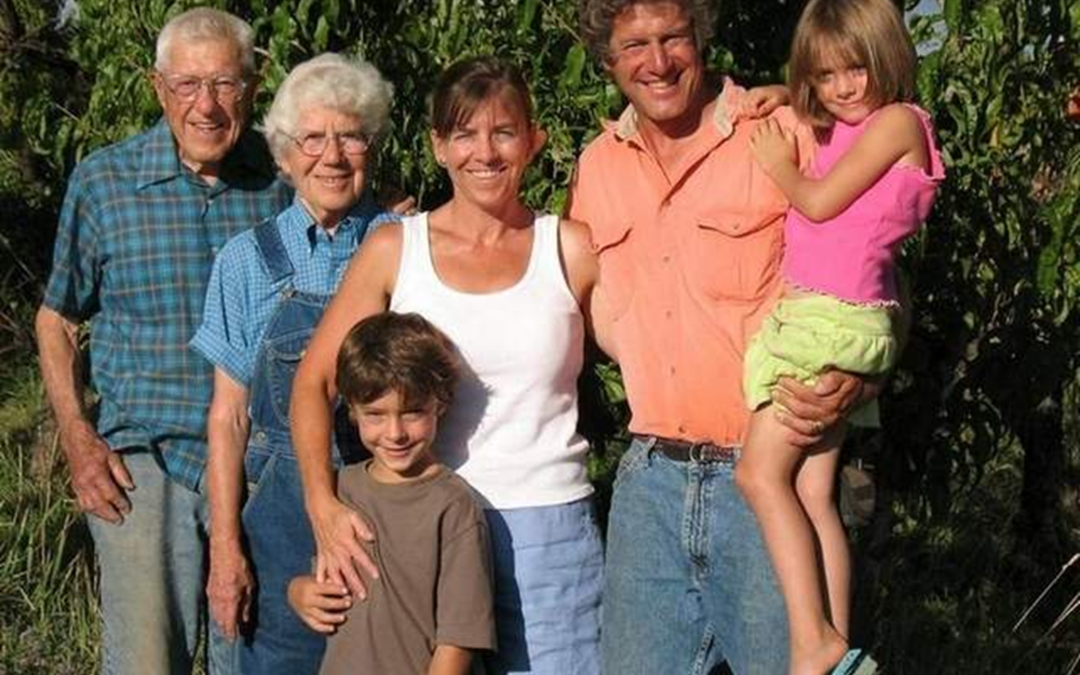
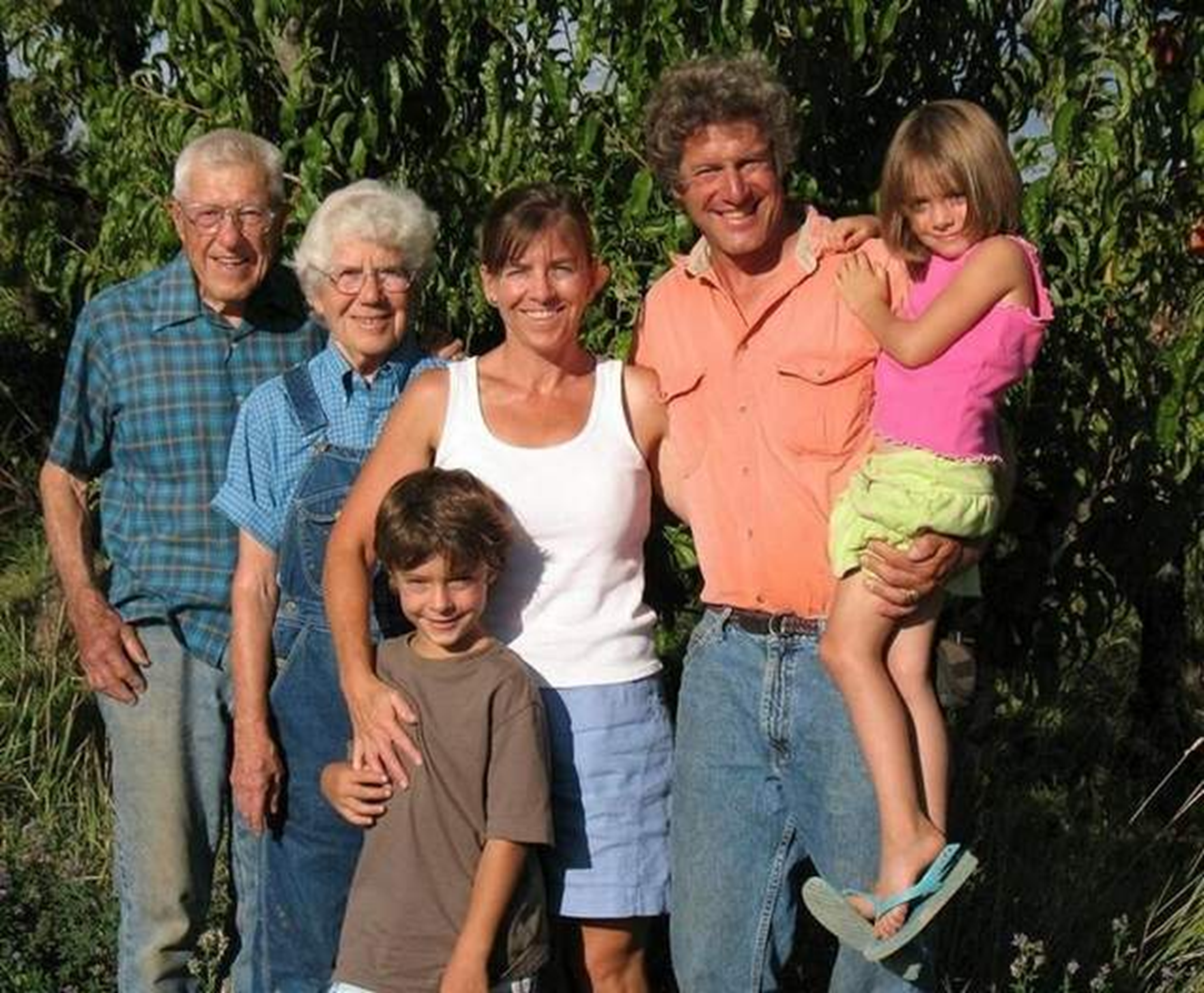
Steve and his parents work on the farm with the help of four employees year-round. They also employ up to eighteen people during the height of the growing season. Ela Family Farms produces about 1.5 million pounds of fruit each year, virtually all of it distributed in Colorado through direct markets as fresh fruit or value-added products such as applesauce, fruit butters, jams and cider. Farm products are sold through the Internet and a CSA, at farmers’ markets all along Colorado’s Front Range and to specialty food stores and gourmet restaurants throughout the state.
When Steve returned to take over the management of his family’s farm after completing college in 1990, he began thinking about diversifying into direct markets and transitioning to certified organic production to improve profitability and environmental quality. He also replaced the existing furrow irrigation system with more efficient sprinkler and drip irrigation, to reduce water use, and began transitioning to new varieties of fruit trees better suited to organic practices and direct markets. Steve can’t say for sure if the weather changes he has noticed are just normal variations or a sign of climate change. What he does know is that more variable weather and a lengthening growing season have required him to make some significant changes in production practices to maintain the productivity and profitability of Ela Family Farms.
“The farm is in what was once known as a relatively frost-free area,” Steve explains. “Historically, it has been in fruit trees since the 1920s, but in the last decade we have had some spring frost damage every year now. Five or six of our earliest bloom years have been in the last ten years.” He has also seen the fall season lengthen noticeably. “There are some varieties of apples, like Fuji, a late-season apple that ten years ago we weren’t sure we could grow here. Now we commonly pick them two weeks before the end of the season.”
Although the lengthening growing season has improved growing conditions for some apple varieties on the farm, production risks have increased, particularly in the last decade. “We’re experiencing earlier springs and more variable temperatures in the spring,” says Steve. “As an example, in 2013, on April fifteenth we were at 13 degrees. That is more typical of February or March temperatures. To get below 20 in April is crazy, and we had two nights below that. So it’s not just early blooming, but late, abnormally cold temperatures. April and May are the huge frost months for us. Peaches bloom mid-April, apples bloom toward the end of April. Any sub-freezing temperatures during that time are pretty destructive. Spring temperatures control whether or not we have a crop.”
Variable spring frosts also create a lot of uncertainty in orchard management, because fruit trees are managed to reduce the number of fruits and to evenly space the fruits on a tree to increase fruit size and quality. The final crop load — the number of fruit remaining on the tree to mature — determines the season’s yield potential. “Not knowing from year to year how much frost damage we are going to have means it’s much more difficult to manage crop load,” Steve explains. “If you’re in an area where you’re not going to have much frost, you can prune and thin in the fall with confidence, because there is a low risk of losing additional fruits to frost damage. Now, we never know from one year to the next how much winter and spring damage we are likely to get, so we have to leave a lot more fruit out there during pruning and early thinning. If it turns out we don’t have frost in the spring, then we’re behind the curve getting it thinned off in the spring. It’s this not knowing which way to jump that is really difficult.”
Steve has also noticed changes in summer and winter weather that have complicated management over the last decade. Warmer and wetter summers have increased disease management challenges. Over the last several years, the hottest time of year has shifted from early August to June, when temperatures regularly reach 100 degrees Fahrenheit, sometimes day after day. Rainfall patterns also seem to be changing. It used to be common for no measurable rain to fall between the end of May through late August, but now consistent light rains in July and August are common. This rain is not enough to water the trees, but leaves them moist enough to increase the risk of disease damage. And winter low temperatures have become more extreme. Recently, Steve had to purchase propane burners and use his wind machines to try and buffer extreme cold temperatures. “Peaches are very sensitive to cold temperatures in the winter,” he says. “We bought our first wind machines in 1991, but I’ve never run them in the winter until the last two years. We have been below critical temperatures for peaches in the winter the last three years, at some point or several times.”
Steve has made other changes on the farm to reduce increased climate risk. He has added more wind machines, makes use of microclimates, and is considering adding protected growing space. Steve explains, “We had a couple of wind machines in ’91. They cost twenty to thirty thousand dollars a piece, so we didn’t buy them all at once. We probably put the last one in about eight years ago to finish covering the whole property. We have a hundred acres, so we have eleven of wind machines.” The farm is on a hill about three quarters of a mile long with a number of swales and other landscape features that influence temperature. “I say we live in a frost-free site, but on some cold nights we can have a four-degree difference across the farm,” explains Steve. “I have some ground out there that has historically been planted in trees, but I will not plant trees there now, because it is a cold pocket and the risk is too high. I’m looking at the warmer spots on the farm and that’s where I put my most sensitive crops.”
Steve is also careful to select frost-tolerant varieties, particularly of peaches. “Within peaches, some varieties are more susceptible than others. When evaluating which peach variety we’re going to use, keep or re-plant, I’m looking at that frost sensitivity. We’re certainly finding varieties that are more likely to come through a spring frost than less likely, even though that means we may have to do more thinning.” Steve is also considering adding frost protection structures to his cherry orchards, because of increasing risk of frost damage in the crop.
Asked about his confidence in the future, Steve notes that he is still in business in an area where fruit farms have declined by 75 percent over the last twenty years. He puts a lot of that down to his choice of direct markets. “We started changing that in 2000 because of bad economics and now we direct market 100 percent of our fruit. We’ve completely changed our business model in twelve years. Fortunately it’s worked, we’re still here. But we’ve made a conscious effort not to play in that international or even national commodity market. We have access to a little higher value market, where we have more control.”
The high returns possible with direct markets have buffered the increased production risks the farm has faced over the last decade. Steve notes that direct markets have also opened up new opportunities for him to diversify crops, because his customers are willing, even eager, to try something new. According to Steve, “With the direct marketing, we have a little more control on price, which means we don’t have to hit a home run every year to still be viable. I’ve looked at the marketing as a way to mitigate some of that crop production risk. Can we still make money if we have a half crop versus having to have a full crop every year?”
He goes on to explain some other benefits of selling his crop this way: “Direct marketing provides some additional risk management because it also means we can pick more varieties that maybe aren’t suitable for wholesale markets, but maybe have characteristics we can handle in direct markets — for example, a variety that’s frost hardy but doesn’t ship well. So we can pick and play with some of those varieties that we haven’t been able to before.” Steve believes that the uniform product requirements of industrial commodity markets increase risks in fruit production because growers are not free to select varieties best adapted to their particular farm conditions.
But there is a downside to direct marketing — it takes a lot of time and some additional skills and it keeps Steve out of the orchard. “I now spend 50 to 60 percent of my time marketing,” he explains, “whereas ten years ago 80 percent of my time was growing. I have become a worse grower because I have to spend my time marketing. As a farm, that has been a good trade-off. We are doing much better than we did before. But I would rather be a grower than a marketer. I’m a decent marketer, I don’t hate it, but I would still rather be a grower. Choosing this marketing avenue that takes a lot more of my time is in part about risk management, which is in part about weather.”
Like many growers in the Southwest, Steve has grave concerns about the future of his farm’s water supply, which is renewed each year by snowpack meltwaters. “Water management is always a concern for us because we’re dependent on irrigation. We’re going to look at the snowpack each year to determine how our water management might have to change. Every year it is different. Our average rainfall here is ten inches, and it does not necessarily fall in the summer when we need it. I’ve had people say to me that with climate change, it gets warmer, and you guys will be set. No, climate change is more variable, which doesn’t help us, and if it’s warmer, we have less snow. We’re absolutely dependent on irrigation water in the summer. And if that regularly becomes less, it will definitely put a crimp on what we can do.”
Steve has leased a neighboring farm purely as insurance against drought. “On this farm we’re on we have adequate water rights in average years,” Steve explains. “In dry years we’re short, so we lease a neighboring farm that is largely fallow right now, mostly for the water, just because it keeps me from getting more gray hair. It’s an insurance policy, that’s what it is. And if other water rights that we can access come up for sale, I’m going to be right in there trying to buy them. Water in the West has always been competitive. If it decreases, and especially if we continue to have population growth, there’s going to be greater and greater pressures on that water for domestic use. It’s going to get ugly.”
Because tree fruits are long-lived, Steve is hopeful, but concerned about the nature of the climate risks facing the farm. “We’re investing a lot of money into planting new trees. It costs somewhere around eight to twelve thousand dollars in the first year to plant a new acre of trees and it’s a ten- or twelve-year payback period if we do everything right. So any time you put more risk in that equation, it’s scary. It’s a dilemma. You can’t really quit planting out of fear, because if you don’t renovate, plant and keep moving forward, pretty soon you’re going to have a bunch of old trees, with nothing coming up beyond them to support the farm. It’s a catch-22 and that is unnerving, and that worries me. It’s certainly something I’ve thought about quite a bit. I feel confident that we have access to some of the best tools and information out there, but does that mean we’re going to successfully manage it? I’m not confident of that at all. Ultimately it’s going to come down to what is economic and what makes sense.”
Steve served as board president of the Organic Farming Research Foundation from 2004 to 2009 and regularly collaborates with University of Colorado researchers on organic fruit production research.

Recent Comments